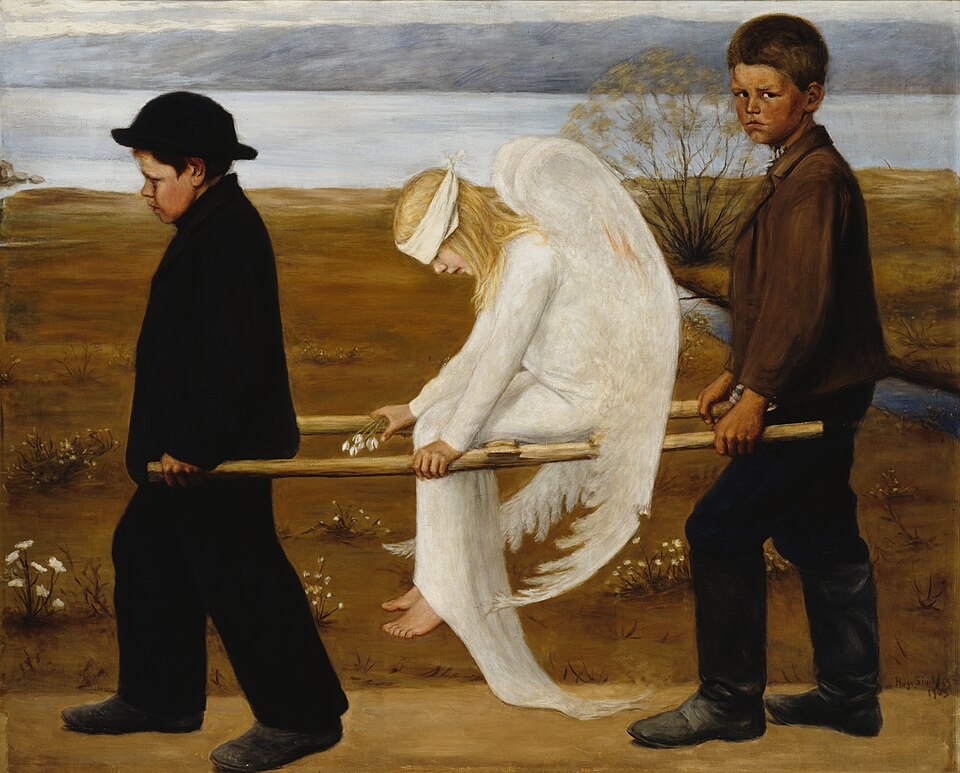
Three figures, all children, walking through a desolate marshland. It barely is spring, the snow drops on the wounded angel seem to tell us. Drab clothes for all, men clothes for the boys, muted pearly white for the angel, unbelievably clean for the wounds, for the dragging. The black of the hatted boy’s jacket seems to remove all light, and yet, there is light in the bowed head behind him, in the blindfold, in the hanging snowdrops, in the front show of the tallest boy, and in his eyes. It is his eyes, you see, what have called me to this painting. It is he, looking out of it, frowning, hands firm on the stretcher, knowingly caught mid-movement, who speaks to me. There is no painting without that gaze, it’d get lost, it’d be just another coloured canvas. But no, he looks and thus so do we. He wonders, and alas, so do we too. What is he thinking? What does he make of his task? Why are they wearing men’s clothes? And where, oh where, are they taking this wounded angel?
It is not the sorrowful yet tender mood or the many questions these odd companions raise that draw me to The Wounded Angel. They are important, but there is something more, a single detail: the wary gaze of the boy on the right. In that hesitation, in his self-awareness and doubt is where my novel, The Wounded Me, is found. Over and over I lose myself in that gaze; it holds me suspended from the rest of the painting and it makes me love it, because it breaks my heart. The boy is engaged in a task that isn’t a boy’s; it shows in his mistrust and defiance. His feet have just completed another step, his hands hold the stretcher steadily, and the rest of his body faces straight ahead. He is bent on continuing, allowing only a moment for our intrusion, the moment Hugo Simberg decided to capture.
In Still Life of Oysters and Lemons, Mark Doty describes what it is to have a connection with a painting:
I have fallen in love with a painting. Though that phrase doesn’t seem to suffice, not really—rather’s [sic] it that I have been drawn into the orbit of a painting, have allowed myself to be pulled into its sphere by casual attraction deepening to something more compelling. I have felt the energy and life of the painting’s will; I have been held there, instructed. And the overall effect, the result of looking and looking into its brimming surface as long as I could, is love, by which I mean a sense of tenderness toward experience, of being held within an intimacy with the things of the world.
Doty, Mark, Still Life of Oysters and Lemon. Boston: Beacon Press: 2001, pp. 3-4.
This gaze belongs in my novel to the narrator, Peter. The boy who looks, the boy whose story this is about. Peter’s gaze pulled me into the orbit of The Wounded Angel and kept me there, igniting the cluster of ideas and questions that became The Wounded Me. They are still there, whenever I look at the painting: Is this boy defensive, angry, sad or annoyed? What would he tell about the task they are engaged in? Has he chosen this, and if so, why does he look unhappy and irritated? Why aren’t there any adults with them? In his view, who is the spectator who has interrupted him? Why do they continue on regardless the interruption? Where are they going? How did they begin to travel together? Why is the angel hurt? In this constant interrogation, my ideas began to take shape. The story of The Wounded Me seemed to be already there in the details. HomeVillage existed: a warped version of a boyish perspective on sorrow and neglect and a blunt reach towards survival, regardless the cost.
In The Wounded Angel I found something recognizable: unforeseen loss and the possibility of hope. This is how I feel about Venezuela, my home and yet home no more, waves of tragedy, strife, hope and mourning, swells and ebbs, decades of them. They’re back again with the earthquakes. Back again with another natural disaster in La Guaira, grandma’s hometown, where she and grandpa met. Back again in more unmeasurable tragedy wrought onto my family and our country. Back once more to mute me, unspeakable as they say sorrow is, an invisible hand wrapped tight around my throat, pain so big it expels me out to space where there is no sound but eternal vibration.
There is sorrow in The Wounded Angel. There is loss. I have found it there, and others have too. Durcan, Heaney, Amaranth. By inhabiting its orbit, I established a connection between emotions and reflections from my personal life and the kind of novel I wanted to write: a beautiful, haunting, delicate tale about the myths of leadership, the risks of following and the complexity of belonging. The Wounded Angel provided me with the mood, aesthetic and characters I needed to deepen my understanding of sorrow and transform these ideas into ‘something more compelling.’[2]
Other central characters in the novel are also connected to the moment this painting captures, in my mind. There’s an older echo of this moment in the leaders of HomeVillage. They, the true brothers, are a group of four siblings who construct HomeVillage, the feral community at the centre of the novel, upon the idea of the eldest one, Michael. And, in imitation of their relationship, they establish a tight hierarchy of emotional bonds and power in the village. In order to sustain themselves and to make the village grow, they rescue other boys like themselves. Only like themselves. The annual journey they carry out back to Belua, their town of origin, symbolizes the true brother’s obsessive repetition of their experiences in the foundation of HomeVillage. The remaking of themselves.
The novel takes place in a fictional world reminiscent of Simberg’s painting. It is a landscape of dualities: Belua and HomeVillage, Peter and Jaime, the bird child and the boys of HomeVillage, the brothers and their followers, one side of the river and the opposite. Holding on to the frown that caught my attention in The Wounded Angel, the novel follows the perspective of Peter, the closest boy to the true brothers and the most desperate for their attention. His wary, mono-focused perspective allowed me to explore from up-close what makes someone follow another fervently. The other boy in the painting, Jamie, is another kind of follower: submissive but instinctive, endowed with a sweet innocence that enables him to explain away the contradictions in HomeVillage. In the angel/bird child, I found their silent witness and a technical challenge, whose differences, juxtaposed to the goals of the brothers, ignite doubts in Peter about his role and their mission.
Often novels inspired by paintings aim to recreate the creative process for which the painting is outcome, re-imagine the difficult life of the painter in its historical context and/or reconstruct the intimate relationship between master and muse. Girl with Pearl Earing by Tracy Chevallier and the critically acclaimed Rembrandt’s Whore by Sylvie Matton are examples of this. I chose instead to write about what I saw in The Wounded Angel, constantly re-examining the painting as I wrote, each time finding new details that informed my work. To help with this, I studied Hugo Simberg and his oeuvre. I also looked into the place of his angel in the Symbolist art movement of the late 19th and beginning of the 20th century. I research others who too had been inspired by this painting. I’ll share some thoughts about this soon.
In the meantime, what about you? Have you fallen in love with any paintings?
The Wounded Me is available at Blackwater Press.

